
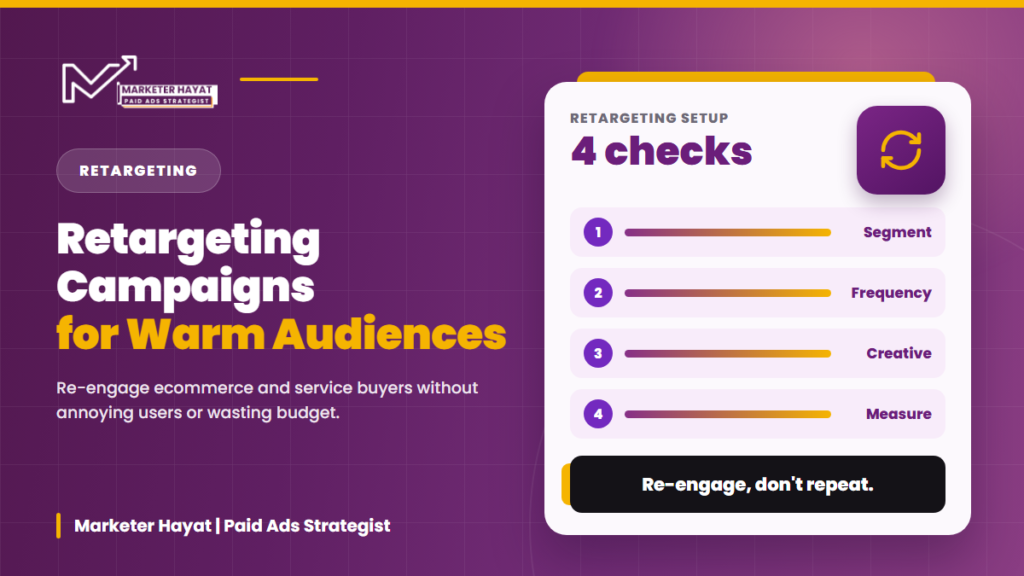
Retargeting Campaigns for Ecommerce and Service Businesses is useful for businesses that already have traffic, visitors, product views, form starts or social engagement but need a clearer second-touch strategy. The goal is not to make reports look busy. The goal is to understand which campaign decisions create returning visitors, completed forms, purchases, booked calls, WhatsApp conversations and recovered carts.
The simple rule is this: before more budget is added, the offer, audience, page, tracking and follow-up path should be clear enough to explain what is working and what needs to change.
What does retargeting Campaigns for Ecommerce and Service Businesses mean?
Meta explains that website custom audiences can be used to retarget people who visited a website but did not convert. In practical paid ads work, that means the platform setup should be connected to the business outcome, not judged only by reach, clicks or surface engagement.
For Marketer Hayat, the useful question is not only whether a campaign produced activity. The better question is whether that activity moved the buyer closer to a lead, sale, appointment, purchase or qualified conversation.
Quick comparison: weak setup vs stronger setup
| Decision area | Weak setup | Stronger setup |
|---|---|---|
| Audience warmth | Cold ads reach people who may not know the offer. | Retargeting reaches people who already interacted with the brand. |
| Message | Cold ads need more context and interest creation. | Retargeting can answer objections, show proof or repeat a relevant offer. |
| Budget role | Cold campaigns often need more testing budget. | Retargeting budgets should match audience size and buying cycle. |
| Risk | Broad cold targeting can be wasteful. | Poor retargeting can annoy users or overstate results without exclusions. |
Why this matters before scaling spend
Paid ads become expensive when the business scales a campaign before the weak point is known. The weak point may be targeting, creative, search intent, landing page clarity, tracking, lead routing, sales follow-up or the offer itself.
That is why the primary service path should connect campaign setup with measurement and follow-up. For local relevance, the campaign should also align with the relevant Marketer Hayat location page.
Which signals should be tracked first?
Start with signals that show real progress. A shallow action can help diagnose behaviour, but it should not be treated as equal to a qualified lead or sale.
Related support: services/tracking analytics setup.
Related support: services/lead generation ads.
Related support: services/ecommerce ads management.
Primary signals
- product views
- add to cart
- checkout start
- lead form open
- landing page visits
- contact-page visits
Secondary signals
- video views
- social engagement
- profile visits
- blog readers
- time-based audience windows
How should a retargeting campaign be built?
The setup should begin with the business model, not the ad platform. A campaign for a service provider, ecommerce store, training institute, clinic, consultant or agency support offer may need a different path even when the ad account looks similar.
- Define the audience based on meaningful behaviour, not every tiny interaction.
- Separate ecommerce and service-business retargeting messages.
- Use exclusions so converted users are not repeatedly pushed the same offer.
- Match the ad to the reason people may not have converted yet.
- Watch frequency, audience size and conversion quality together.
Common mistakes to avoid
Most poor campaign decisions are not caused by one setting. They usually come from several small gaps that make the data harder to trust.
- retargeting everyone with the same ad
- forgetting customer or converted-lead exclusions
- using aggressive discounts too early
- claiming retargeting success without checking overlap and attribution
Practical recommendation by business type
Ecommerce brands
Retarget product viewers, cart users and checkout starters with product-specific reminders or stronger proof.
Service businesses
Retarget page visitors with FAQs, process clarity, proof and a lower-friction contact path.
Small audiences
Keep the budget modest so frequency does not climb too quickly.
How Faisal Saleh Hayat reviews this setup
Faisal Saleh Hayat reviews paid ads by looking at the full path from campaign to outcome: offer, audience or keyword intent, creative, landing page, tracking, lead quality and follow-up. This keeps the review connected to business decisions instead of isolated platform metrics.
For proof context, review the relevant case study path. For broader channel planning, read this related article, related article 2.
Final answer: what should you do first?
Fix the decision system before increasing the budget. That means choosing the right campaign goal, using the right page or form, tracking the important actions, reviewing lead or purchase quality and deciding the next test from evidence.
If you want help reviewing this path, contact Marketer Hayat through the contact page or learn more about Faisal Saleh Hayat.
FAQs
What is retargeting in paid ads?
Retargeting is advertising to people who previously interacted with a website, ad, social profile, product page or lead path. It is meant to bring warm users back with a more relevant message.
Does retargeting work for service businesses?
Yes, when the audience is meaningful and the message answers the next buyer question. It should not be treated as a replacement for offer clarity or follow-up.
How much budget should go to retargeting?
It depends on audience size and purchase cycle. Smaller audiences usually need smaller budgets to avoid high frequency and wasted impressions.
Written by Faisal Saleh Hayat, paid ads strategist and founder of Marketer Hayat. He helps ecommerce brands, service businesses and agencies improve Meta Ads, Google Ads, conversion tracking, landing pages and campaign decision-making.

