
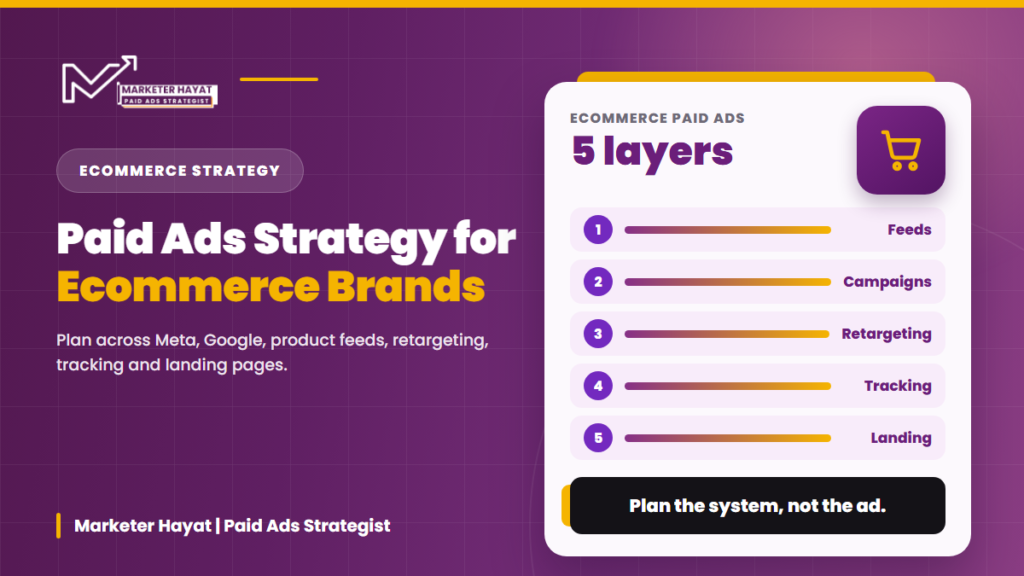
Paid Ads Strategy for Ecommerce Brands in Pakistan is useful for ecommerce brands that need paid traffic to connect with product economics, inventory, conversion tracking and repeat purchase learning. The goal is not to make reports look busy. The goal is to understand which campaign decisions create purchases, revenue, checkout starts, add-to-cart events, qualified product enquiries and customer value signals.
The simple rule is this: before more budget is added, the offer, audience, page, tracking and follow-up path should be clear enough to explain what is working and what needs to change.
What does paid Ads Strategy for Ecommerce Brands in Pakistan mean?
Google describes Performance Max as a goal-based campaign type that can access Google Ads inventory from one campaign. Meta catalog guidance connects product data and pixel signals for catalog-based advertising. In practical paid ads work, that means the platform setup should be connected to the business outcome, not judged only by reach, clicks or surface engagement.
For Marketer Hayat, the useful question is not only whether a campaign produced activity. The better question is whether that activity moved the buyer closer to a lead, sale, appointment, purchase or qualified conversation.
Quick comparison: weak setup vs stronger setup
| Decision area | Weak setup | Stronger setup |
|---|---|---|
| Campaign role | Prospecting introduces products to new buyers. | Retargeting brings back warm visitors, cart users and past buyers. |
| Product data | Weak titles, prices or images limit shopping and catalog performance. | Cleaner feeds help platforms understand what should be promoted. |
| Creative | One generic ad rarely explains every product angle. | Creative should match product, offer, objection and buying stage. |
| Measurement | ROAS alone can hide margin, stock and repeat-purchase issues. | Revenue, profit context and customer quality should guide scaling. |
Why this matters before scaling spend
Paid ads become expensive when the business scales a campaign before the weak point is known. The weak point may be targeting, creative, search intent, landing page clarity, tracking, lead routing, sales follow-up or the offer itself.
That is why the primary service path should connect campaign setup with measurement and follow-up. For local relevance, the campaign should also align with the relevant Marketer Hayat location page.
Which signals should be tracked first?
Start with signals that show real progress. A shallow action can help diagnose behaviour, but it should not be treated as equal to a qualified lead or sale.
Related support: services/tracking analytics setup.
Related support: services/google ads management.
Related support: services/meta ads management.
Primary signals
- purchase event
- purchase value
- add to cart
- checkout start
- product page view
- new vs returning customer signals
Secondary signals
- view content
- collection page visits
- creative saves or engagement
- email or WhatsApp product enquiries
- coupon usage
How should ecommerce paid ads be planned?
The setup should begin with the business model, not the ad platform. A campaign for a service provider, ecommerce store, training institute, clinic, consultant or agency support offer may need a different path even when the ad account looks similar.
- Start with product economics, margin, average order value and stock readiness.
- Fix product feed, tracking and checkout issues before heavy scaling.
- Use Meta and Google for different parts of demand creation and demand capture.
- Separate prospecting, retargeting and retention decisions.
- Review revenue with margin, delivery, returns and customer quality where possible.
Common mistakes to avoid
Most poor campaign decisions are not caused by one setting. They usually come from several small gaps that make the data harder to trust.
- scaling ads before the store can track purchases correctly
- judging products only by ad clicks
- using one creative angle for every product
- ignoring checkout friction, delivery promise and mobile speed
Practical recommendation by business type
New ecommerce stores
Validate product-market response and tracking before pushing large budgets.
Growing stores
Separate winning products, weak products and seasonal offers in reporting.
Stores with repeat buyers
Use customer lists and retention offers carefully instead of treating every buyer as new.
How Faisal Saleh Hayat reviews this setup
Faisal Saleh Hayat reviews paid ads by looking at the full path from campaign to outcome: offer, audience or keyword intent, creative, landing page, tracking, lead quality and follow-up. This keeps the review connected to business decisions instead of isolated platform metrics.
For proof context, review the relevant case study path. For broader channel planning, read this related article, related article 2.
Final answer: what should you do first?
Fix the decision system before increasing the budget. That means choosing the right campaign goal, using the right page or form, tracking the important actions, reviewing lead or purchase quality and deciding the next test from evidence.
If you want help reviewing this path, contact Marketer Hayat through the contact page or learn more about Faisal Saleh Hayat.
FAQs
Which paid ads platform is best for ecommerce in Pakistan?
There is no single answer. Meta can create and retarget demand, while Google can capture shopping and search intent. The best mix depends on product, price, margin, demand and tracking.
Should ecommerce brands start with Meta Ads or Google Ads?
Start where the product has the clearest buying path. Visual impulse products may start on Meta, while search-driven or comparison-heavy products may need Google earlier.
What should ecommerce brands track first?
Track purchases, revenue, add to cart, checkout start, product views and source-level campaign data. Without this, scaling decisions become guesswork.
Written by Faisal Saleh Hayat, paid ads strategist and founder of Marketer Hayat. He helps ecommerce brands, service businesses and agencies improve Meta Ads, Google Ads, conversion tracking, landing pages and campaign decision-making.

